Showing posts with label Herbal medicine. Show all posts

Tuesday, 14 October 2014

Bodrum Talks Teas.

Photo credit - Robert Patrick
Friday's talk gave us a few reasons to sweat;  tricky translations, non-compatable memory sticks, non-existent air-con and the inevitable mobile phones piping up every so often, but over all it went very well and more people than expected turned up. 
I've been asked to transcribe the whole talk for the H3A website, so I'll  put the link on here when it's available. But, in the meantime, here is a snippet: 


Ilhamur 
Linden Flower Tea  - Ihlamur

Linden is an herb that comes from various species of Tilia or Lime Tree. The flowers were historically used to soothe nerves and treat health problems associated with anxiety. These flowers were steeped as a tea to relieve indigestion, irregular heartbeat, and vomiting. Today, linden is used in many cough and cold remedies. Active ingredients in linden help promote sweating, which may help treat people with fevers. Tilia has been studied in only a few test tube and animal trials. It appears to have antispasmodic (reducing muscle contractions), astringent (drying), diuretic, and sedative properties.
Frequent use of linden has been linked with heart damage. Do not use without medical supervision if you have heart disease.


Kara baş otu
French lavender – Kara baş otu

French lavender tea is used in Turkey mainly to remedy forgetfulness, and is thought to be useful against Altzheimers. It is also used for good blood flow and against coughs. The tea is sold in Turkey as a cure all for heart and circulation problems, stress, insomnia, prostate problems, high cholesterol, shifting mucus, bronchitis, muscle pains, head aches, and hand tremors. Use the flowers to make tea, and either drink or use the liquid to bathe an aching area, or mix the flowers with honey and eat. 


Olive leaves


Olive leaf - Zeytin yapragı

In the early 20th century, a bitter compound called oleuropein was discovered in olive leaves and in the past 20 years this substance has undergone considerable research.
Initial results show positive results in boosting the immune system against both viral and bacterial attack, promoting increased energy levels, strengthening the cardiovascular system and helping ease aching muscles.

As the winter cold and flu season approaches, I produce my own olive leaf extract. The easiest method is to collect a handful of leaves from trees that haven't been sprayed, chop and infuse in almost boiled water for 5 minutes, strain and drink. The leaves can also be dried and made into tea. I admit it's not a very pleasant taste, but it improved with a teaspoon of honey.
The second way is to steep the leaves in alcohol, olive oil or glycerine  to make a tincture. I pop a few handfuls of leaves into a blender then pushed them into a clean glass bottle and fill it up with vodka. I turn it every day and after 6 weeks I have my tincture. Half a teaspoon morning and night seems to be the recommended dose, although tests at over 100 times this amount showed no harmful effects. I don’t take it all the time, just when I feel a cold or sore throat coming on.

This formula can now be bought over the counter in pharmacies and herbalists in the UK and Turkey. 


Friday, 26 September 2014

Nature's Medicine Cabinet.

I've been talked into giving a lecture on the natural remedies found in this part of Turkey and this has had me going through all my old posts looking for inspiration.  I was surprised to find a few that I'd written, but never posted. It's always a nice surprise to find a ready-made blog post that only needs a bit of updating.

St John's Wort - Kantaron


If you walk around any rural market in this area, you will see plastic water bottles filled with a red or burgundy coloured oil.  If you ask what it is you'll be told "Kantaron" or Kantron" and this will be accompanied by a mime of rubbing an arm or face. The bottle will set you back between 7 and 10 TL and I suggest you purchase a supply for your medicine cupboard. What you are actually buying is a tincture of St John's Wort, which for centuries has been a renown cure-all. In ancient times it was hung over front doors to ward off evil and disease.  In Germany it is medically accepted as an effective treatment for depression and in Turkey it is used to cure boils, burns, cuts, cold sores, piles, insect bites. muscle pain and ear-ache. My fellow blogger Ayak, was sold some by a pharmacist to treat a dog bite and she was impressed at its curative properties.  It is clinically proven to be anti-bacterial and anti-inflammatory. It is also undergoing trials to see if it is effective in treating age-related memory loss, and tests on mice are positive so far. (Do mice have problems remembering where they left their keys?) It is also traditionally used in some countries, (but not here) to reduce cravings for alcohol.


It has its drawback backs though.  It interacts with many commonly taken drugs, so should never be used if you are taking prescribed medicine without first checking with your doctors, especially if you are taking anti-depressants.  It also makes skin sensitive to sunlight, so if using it you have to keep well in the shade.  It is poisonous to cattle, but the effects of the poison are reduced if the animals are kept out of the sun.


It is a common weed, so now you've seen the picture, you will notice it everywhere,  especially in Spring.  To make the tincture, either the buds of the plant or the seed pods are collected and put in jars for 24 hours, then olive oil is poured on top and the jars left in the sun for 6 to 8 weeks. The resulting red liquid is then strained into bottles.  The whole plant is often pulled up and dried and used as tea, and in other countries, 40 grams of flowers are infused in 1 litre of wine, left for a month, strained and sweetened and 2 tablespoons are taken daily as a pick-me-up!

The more I research local remedies, the more I find that are backed up by scientific studies.  It's a fascinating subject.

Sunday, 7 September 2014

Her Derde Deva - Küdret Narı. Bitter Gourd


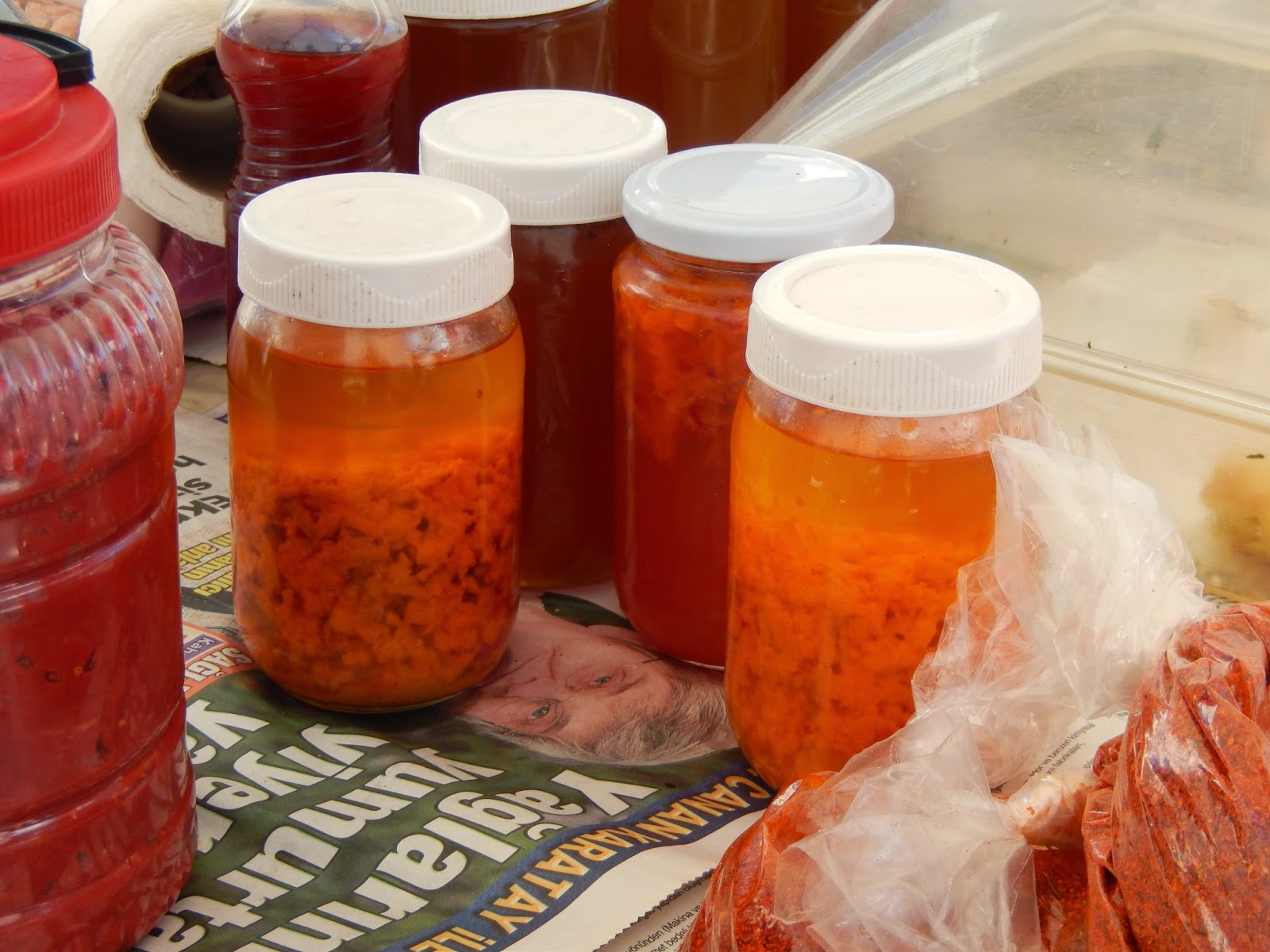
Excuse me breaking into Turkish, but "her derde deva" sounds so much better than "universal cure".  The village markets are full of jars and bottles which claim to be a panacea for every ill known to mankind and I used to be pretty sceptical, but the more research I do, the more faith I put in these local remedies.  My poor daughter has been diagnosed with a thyroid problem which, indirectly, has caused her insulin levels to rise so she has been prescribed Metformin.  This drug has horrible side effects and her suffering prompted me to comb the internet for alternatives and I found one that is on sale at almost every market in Bodrum. Bitter gourd or Küdret Narı has been proven to be almost as effective as Metformin at reversing insulin resistance and lowering blood sugars. Interestingly,  when I bought some of the fruit this week, I was told it was good for heartburn, acid reflux, stomach ulcers and skin complaints.  It is either sold macerated in olive oil or honey, so I was lucky to find the whole fruit.  In the East, it is treated as a vegetable and picked green, when it is less bitter, and cooked in stews and stir fries, juiced or eaten raw. 


Care should be taken in preparation as the red pulp covering the seeds is poisonous, but the rest of the fruit is edible and the leaves can be used for tea.  It grows prodigiously and the vine can reach 5 meters in height.  I've saved some seeds and will plant them next May and see if I can get my own vine growing.  If you are diabetic or on insulin lowering medication only try this vegetable in consultation with your doctor, as you might find your sugar levels dipping too low.